
How AI is fundamentally reshaping what it means to be a developer, and what separates those who thrive from those who get left behind
The Job That No Longer Exists?
The software developer job description you posted six months ago is already obsolete. Not because the technology changed, but because the fundamental nature of the work has shifted beneath our feet.
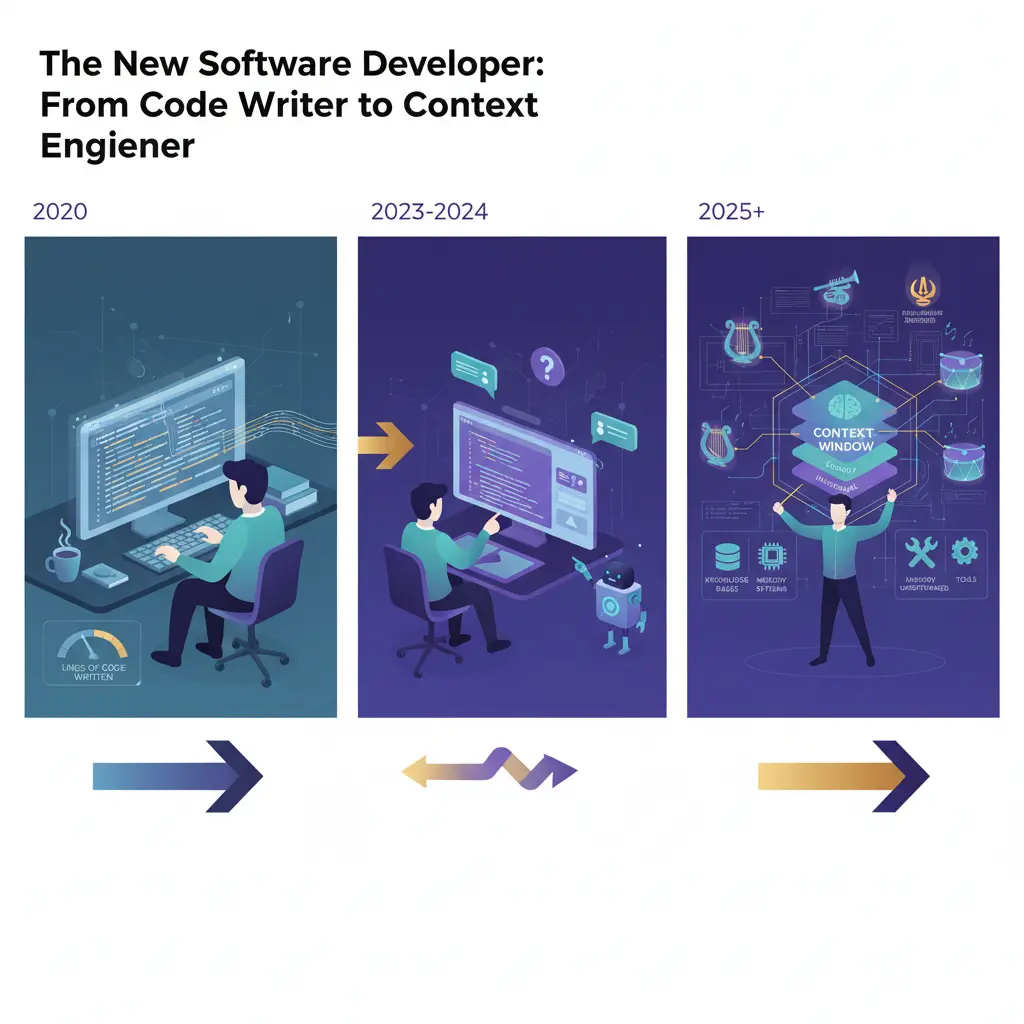
In 2020, a productive developer wrote 200-400 lines of quality code per day. They spent their time thinking through logic, typing out implementations, debugging syntax errors, and refactoring for clarity. The bottleneck was human typing speed and cognitive bandwidth.
In 2025, that same developer can generate 2,000 lines of code before lunch using Claude or GPT-4. The bottleneck isn’t generation anymore. It’s understanding, verification, and integration. The skillset that made someone an excellent developer in 2020 is necessary but no longer sufficient in 2025.
This isn’t a think piece about the future. This is a field report from engineering leaders managing teams right now, grappling with a fundamental question: What does a software developer actually do when AI writes most of the code?
The answer determines who gets promoted, who gets hired, and who becomes indispensable as AI capabilities accelerate.
The Collapse of Traditional Developer Hierarchies
The Junior Developer Crisis
For twenty years, the career path was predictable: junior developers wrote simple CRUD endpoints and learned by doing. They made mistakes in low-risk areas. Senior developers reviewed their code, caught the bugs, and explained better approaches. After two years of this apprenticeship, juniors became mid-level developers who could handle more complex tasks independently.
That progression model is breaking down.
AI can now generate the “learning code” that juniors used to write. The simple CRUD endpoint, the basic authentication middleware, the straightforward data validation, these are exactly what AI handles best. A junior developer with Claude can produce code at the volume and quality that would have taken them two years to reach in 2020.
But here’s the problem: they didn’t earn those two years of mistakes and learning. They can generate an authentication system, but they can’t explain why bcrypt is preferable to MD5. They can scaffold a REST API, but they don’t understand when to use PUT vs PATCH. The code works, but they can’t maintain it.
Even worse: the traditional junior developer role, the one where you learn by writing lots of simple code, no longer exists in many organizations. Why hire a junior to write CRUD endpoints when a mid-level developer with AI can do it 10x faster?
The gap between “knows how to prompt AI” and “understands software engineering” has never been wider.
The Mid-Level Squeeze
Mid-level developers are feeling pressure from both directions.
From below: junior developers with AI assistance can replicate their output volume. That RESTful API you’d spend a week building? A junior with good prompts generates it in a day.
From above: senior developers with AI assistance can handle the entire project scope that used to require a team. That feature requiring three mid-level developers for a month? One senior with AI ships it in two weeks.
The mid-level developers who survive this squeeze are the ones who recognize that volume is no longer their value proposition. Their value is in judgment, pattern recognition across the codebase, and the ability to see second-order consequences that AI can’t predict.
The Senior Developer Evolution
Senior developers always had two jobs: write code and mentor juniors. The mentorship worked through code review, pair programming, and progressive delegation of more complex tasks.
Both of those mechanisms are breaking. Code review volume has increased 10x (because AI generates that much more code), making thorough review impossible. Pair programming with AI in the loop means the junior isn’t learning problem-solving, they’re learning prompt-crafting.
The senior developers thriving in 2025 have shifted their role entirely. They’re not writing less code, they’re writing different code. They focus on:
- Architectural decisions that AI can’t make: Should this be synchronous or asynchronous? Monolith or microservices? SQL or NoSQL?
- Context curation for AI: What constraints, patterns, and principles should guide code generation?
- Code review at scale: How do you review 10x more code without becoming a bottleneck?
- Integration oversight: How do ten AI-generated modules fit together into a coherent system?
The seniors who are still trying to compete on typing speed are being outpaced. The ones who’ve embraced being architects and curators are more valuable than ever.
Context Engineering: The Core Competency
When people talk about “prompt engineering,” they’re focused on the wrong thing. Prompt engineering is asking the right question. Context engineering is providing the AI with everything it needs to generate the right answer.
What Context Engineering Actually Means
Context engineering is the practice of systematically managing the information environment in which AI operates. It’s not a single prompt, it’s a framework for:
- Determining what information the AI needs
- Structuring that information for maximum effectiveness
- Maintaining consistency across multiple AI interactions
- Validating that the context is producing desired outcomes
Let’s break down each component with a real example.
Example: Building a Payment Processing System
Bad Approach (Prompt Engineering Only)
"Create a function that processes credit card payments"The AI generates a function that:
- Accepts card number, expiration, CVV
- Makes an API call to a payment processor
- Returns success or failure
It compiles. It runs. It’s completely unsuitable for production because it doesn’t handle:
- PCI compliance requirements
- Retry logic for network failures
- Idempotency (preventing duplicate charges)
- Webhook handling for asynchronous results
- Fraud detection integration
- Currency conversion
- Tax calculation
- Subscription vs one-time payment differences
Good Approach (Context Engineering)
Step 1: Business Context Provide the AI with your specific business requirements:
We're building a B2B SaaS platform with:
- Monthly and annual subscription plans
- Usage-based billing for API calls
- Multi-currency support (USD, EUR, GBP)
- Enterprise customers requiring invoice payment
- PCI-DSS compliance requirement for SOC 2
Step 2: Technical Context Share your existing architecture:
Our stack:
- Python/Django backend
- PostgreSQL database
- Redis for caching
- Stripe as payment processor
- Existing error handling pattern: custom exceptions, structured logging
- Existing API patterns: Django REST framework serializers
Step 3: Constraints and Requirements Define what good looks like:
Requirements:
- Idempotent payment processing (use idempotency keys)
- Retry logic: 3 attempts with exponential backoff
- Webhook signature verification for Stripe callbacks
- All payment data logged to separate compliance database
- Failed payments trigger email to finance team
- Support for payment method updates without new charge
Step 4: Examples from Your Codebase Show the AI your existing patterns:
python# Existing error handling pattern we use
class PaymentError(Exception):
    def __init__(self, message, error_code, user_facing_message):
        self.error_code = error_code
        self.user_facing_message = user_facing_message
        super().__init__(message)

# Existing logging pattern
logger.info(
    "payment_attempted",
    extra={
        "user_id": user.id,
        "amount": amount,
        "currency": currency,
        "plan_id": plan.id
    }
)
Step 5: Edge Cases from Production Experience
Share what you’ve learned:
Edge cases we've encountered:
- Card expiration during subscription renewal
- Failed backup payment method
- Partial refunds when downgrading mid-cycle
- Currency conversion on international cards
- Disputes and chargeback handling
- Account suspensions affecting payment processing
Now you ask: “Create a payment processing function that handles these requirements.”
The AI generates code that:
- Follows your existing patterns
- Handles your specific edge cases
- Integrates with your architecture
- Respects your constrains
- Uses your error handling conventions
- Logs in your format
That’s context engineering.
The Context Management Problem at Scale
Here’s where it gets hard: as your codebase grows, the context needed to generate good code grows exponentially. A 50,000-line codebase has architectural decisions, naming conventions, error handling patterns, testing standards, and domain-specific logic that need to be captured and provided to the AI.
The Context Pyramid:
Level 1: Universal Context (Always Needed)
- Programming language and version
- Framework and dependencies
- Coding standards (PEP 8, ESLint rules, etc.)
Level 2: Project Context (Most Sessions)
- Architecture patterns (MVC, microservices, etc.)
- Database schema for relevant tables
- API contracts for integrations
- Error handling conventions
- Testing approach
Level 3: Domain Context (Specific Features)
- Business rules for this feature
- Regulatory requirements
- Edge cases from production
- Related features that might interact
Level 4: Historical Context (Complex Changes)
- Why previous approaches were tried and abandoned
- Technical debt that can’t be fixed yet
- Known limitations to work around
- Performance bottlenecks to avoid
A senior developer on a mature project spends 30-40% of their time curating context before writing a single line of code. They’re:
- Extracting relevant architecture docs
- Identifying which existing modules interact with the new feature
- Documenting constraints that aren’t obvious from code
- Gathering examples of correct patterns from the codebase
- Explaining business context that lives in Slack threads and meeting notes
This is why AI-generated code quality degrades as projects mature. Developers don’t scale their context engineering practices to match codebase complexity. They keep writing simple prompts for complex problems, and the AI fills gaps with generic patterns that violate unstated architectural principles.
Architecture: The Non-Delegable Responsibility
AI will write whatever function you ask for. It won’t tell you you’re building the wrong function.
The Architectural Blind Spots
Problem 1: AI Optimizes Locally, Not Globally
You ask AI to “create a caching layer for user profiles.” It generates a perfectly functional Redis-based cache with TTL, invalidation logic, and error handling. What it doesn’t know:
- You already have a caching layer for a different entity that uses a different pattern
- Your codebase has a design principle: “cache at the API gateway, not in the service layer”
- Three months ago, the team tried this exact approach and removed it because it caused cache consistency bugs
The AI made a good caching layer. It made it in the wrong place, using the wrong pattern, solving a problem you already solved differently elsewhere.
Problem 2: AI Can’t Evaluate Tradeoffs
You ask AI: “Should this API call be synchronous or asynchronous?”
The AI will answer based on generic best practices: “Asynchronous is better for performance and scalability.”
What it can’t evaluate:
- Your users need immediate feedback, not eventual consistency
- Your infrastructure team doesn’t want to manage a message queue yet
- Your compliance requirements mandate synchronous audit logging
- Your frontend team doesn’t have experience with async patterns
The architecturally correct answer isn’t in a textbook. It’s in your specific organizational context.
Problem 3: AI Doesn’t Understand System Boundaries
You’re building a feature that needs to send emails. You ask AI to “create an email sending service.”
The AI generates a complete email service with templates, queue management, retry logic, and delivery tracking. Beautiful code. Completely wrong.
You already have an email service. What you needed was integration with that existing service, not a new one. Now you have two email systems, different retry behaviors, inconsistent template management, and operational complexity.
The Architecture Skills That Matter
Systems Thinking
- How does this component interact with everything else?
- What happens when this fails?
- What happens when load increases 10x?
- What’s the blast radius of a bug here?
Tradeoff Evaluation
- What are we optimizing for? (Speed, reliability, cost, simplicity?)
- What constraints matter? (Time, team skill, infrastructure, budget?)
- What’s the maintenance cost?
- Can we reverse this decision later if we’re wrong?
Pattern Recognition
- Have we solved something similar before?
- What did we learn from that?
- Which patterns work well in our codebase?
- Which patterns have we explicitly decided against?
Future Proofing
- What are we building toward?
- What flexibility do we need?
- What can we hardcode for now?
- Where should we over-engineer for known growth?
These are human judgment calls. AI can’t make them because they require:
- Understanding organizational context
- Historical knowledge of what’s been tried
- Awareness of team capabilities
- Vision for where the product is heading
- Tolerance for ambiguity
Code Review at 10x Scale
When AI generates 10x more code, code review becomes 10x more critical and 10x harder.
Why Traditional Code Review Fails
Review Fatigue is Real
A human reviewing their 50th AI-generated function of the day stops seeing problems. The pattern recognition that catches bugs on function #5 is exhausted by function #30. You start looking for showstopper bugs (will it crash?) rather than subtle issues (is this the right approach?).
Volume Creates Pressure to Approve
Teams measure velocity by merged PRs. When AI generates 10x more code, there’s 10x more pressure to merge it. The bottleneck shifts from writing code to reviewing code, and that bottleneck gets optimized by lowering review standards.
Complexity Hides in Plain Sight
AI-generated code often looks correct at first glance. It compiles, tests pass, and the logic seems sound. The problems are deeper:
- It duplicates functionality that exists elsewhere
- It uses a deprecated pattern you’re moving away from
- It violates an architectural principle that isn’t documented
- It makes assumptions that are true now but won’t be in six months
The New Code Review Framework
Checklist-Driven Review
Instead of freeform review, use explicit checklists:
Security Checklist:
- No hardcoded credentials or secrets
- Input validation on all user-supplied data
- Authentication and authorization checked
- SQL queries parameterized, not string concatenated
- Sensitive data logged appropriately (masked/excluded)
- Rate limiting on external-facing endpoints
Maintainability Checklist:
- No code duplication with existing modules
- Follows team naming conventions
- Error messages are actionable
- Edge cases documented
- Complex logic has explanatory comments
- Dependencies justified and minimal
Integration Checklist:
- Consistent with codebase patterns
- Uses existing utilities rather than reinventing
- Follows team architectural principles
- API contracts match documented standards
- Database changes include migrations
- Backwards compatible with existing features
Automated Pre-Review
Before human review, run automated checks:
- Static analysis for security vulnerabilities
- Duplicate code detection
- Complexity metrics (cyclomatic complexity, nesting depth)
- Test coverage requirements
- Performance profiling for hot paths
- Dependency vulnerability scanning
These catch the mechanical issues, letting humans focus on judgment calls.
Tiered Review Process
Not all code needs the same review depth:
Tier 1 (Full Review):
- Authentication/authorization logic
- Payment processing
- Data migrations
- API contract changes
- Security-sensitive operations
Tier 2 (Standard Review):
- New feature implementations
- Significant refactors
- Integration with external services
- Database queries
Tier 3 (Fast Review):
- Bug fixes in well-understood code
- UI text changes
- Configuration updates
- Documentation
What Reviewers Should Actually Review
Don’t review syntax. Let linters handle that. Don’t review test coverage. Let automation check that.
Review for:
- Correctness of Intent
- Does this solve the actual problem?
- Are the requirements interpreted correctly?
- What happens in failure cases?
- Architectural Consistency
- Does this fit our patterns?
- Is this in the right layer?
- Does it introduce new patterns we’ll regret?
- Hidden Assumptions
- What does this assume about data shape?
- What does this assume about call frequency?
- What does this assume about user behavior?
- Future Maintainability
- Can someone understand this in six months?
- What happens when requirements change?
- Is this over-engineered or under-engineered?
- Integration Gotchas
- What existing code does this affect?
- What might break that isn’t covered by tests?
- What downstream systems rely on this?
Domain Knowledge: The Unreplicable Moat
AI knows programming. It doesn’t know your business.
Why Domain Knowledge Matters More Than Ever
Example 1: Insurance Claims Processing
A generic developer with AI builds a claims validation system. The code is clean, well-tested, and handles edge cases. It goes to production and immediately causes problems.
Why? The AI-generated validation allows claims filed after policy cancellation. The developer didn’t know that in insurance, “policy effective date” and “coverage period” are different concepts. A policy can be cancelled but still cover incidents during the coverage period.
A developer with insurance domain knowledge would have provided context about policy lifecycles, grace periods, and retroactive cancellations. The AI would have generated correct validation logic.
Example 2: Healthcare Data Retention
A developer builds a data archival system that deletes records after seven years to comply with GDPR “right to be forgotten.” Looks good. Totally wrong.
Healthcare records in the US must be retained for specific periods that vary by state and record type. Some must be kept indefinitely. The developer didn’t know that HIPAA supersedes GDPR for healthcare data in many contexts.
A developer with healthcare domain knowledge would have provided context about retention schedules, regulatory hierarchies, and state-specific requirements. The AI would have generated compliant archival logic.
Example 3: Financial Audit Trails
A developer refactors a payment system to improve performance by removing “redundant” logging. The code is 30% faster and tests pass. Deploy goes smoothly until the finance team notices their audit reports are incomplete.
The “redundant” logs weren’t redundant. They were legally required audit trails for financial transactions. The developer didn’t know that every state change in a financial transaction needs to be immutably logged, even if it seems repetitive.
A developer with fintech domain knowledge would have known to preserve audit logging patterns and wouldn’t have flagged them as technical debt.
Building Domain Knowledge
For Individual Developers:
- Shadow Domain Experts
- Attend meetings with product managers, customer success, sales
- Ask “why” questions about business rules
- Review customer support tickets to understand real-world usage
- Read Industry Documentation
- Regulatory requirements for your industry
- Industry standards and best practices
- Common failure modes and lessons learned
- Study the Business Model
- How does the company make money?
- Who are the customers and what do they care about?
- What are the business metrics that matter?
- What are the competitive dynamics?
- Learn from Production Incidents
- Why did it break?
- What business process was affected?
- What assumptions were wrong?
For Engineering Leaders:
- Embed Engineers in Business Contexts
- Rotate engineers through customer support for a week
- Have engineers join sales calls
- Send engineers to customer sites
- Include engineers in business strategy meetings
- Document Domain Knowledge
- Maintain a domain model wiki
- Create runbooks for common business scenarios
- Document regulatory requirements
- Capture edge cases from production
- Hire for Domain Experience
- Engineers with industry background are increasingly valuable
- They provide context AI can’t generate
- They catch domain-specific bugs before production
The New Developer Skillset Hierarchy
What makes a developer valuable in 2025?
Tier 1: Table Stakes (Everyone Needs These)
- Prompt crafting: Can describe what you want clearly
- Basic code reading: Can understand AI-generated code
- Testing fundamentals: Can write tests and verify correctness
- Version control: Can use Git effectively
- Basic debugging: Can use debugger and read stack traces
These skills are necessary but not sufficient. They’re the minimum bar, not the differentiator.
Tier 2: Professional Competency
- Context engineering: Can provide comprehensive context to AI
- Pattern recognition: Recognizes when AI-generated code duplicates existing functionality
- Code review depth: Can review for architectural consistency, not just correctness
- Problem decomposition: Can break complex problems into AI-solvable chunks
- Integration thinking: Understands how pieces fit together
These skills separate mid-level from junior developers.
Tier 3: Senior Excellence
- Architectural judgment: Makes system-level decisions AI can’t make
- Tradeoff evaluation: Balances competing concerns (speed, reliability, cost, simplicity)
- Domain expertise: Deep understanding of business context and constraints
- Context curation at scale: Maintains architectural decision records, patterns, and constraints
- Code review at scale: Can review 10x volume without compromising quality
- Team force multiplication: Makes entire team more effective with AI
These skills determine who becomes technical leads and architects.
Tier 4: Distinguished Engineer
- System vision: Sees what the system needs to become, not just what it is
- Organizational context engineering: Shapes how entire engineering org uses AI
- Platform thinking: Builds tools and frameworks that make everyone more effective
- Technical strategy: Aligns technology choices with business direction
- Knowledge synthesis: Turns tribal knowledge into documented, AI-accessible context
These engineers are the rarest and most valuable. They’re not competing with AI—they’re orchestrating it.
Practical Implementation: What to Do Monday Morning
For Individual Developers
This Week:
- Start documenting context before using AI
- Write down business requirements
- List constraints and edge cases
- Gather examples from existing code
- Measure: does this improve output quality?
- Review your last three AI-generated features
- What bugs appeared later?
- What context was missing?
- What would you provide differently now?
This Month: 3. Build a personal context library
- Common patterns in your codebase
- Architectural principles that guide decisions
- Domain-specific rules and edge cases
- Reusable prompts that work well
- Shadow someone outside engineering
- Sales, customer success, product management
- Learn what they care about
- Understand the business context
This Quarter: 5. Develop domain expertise
- Read industry regulations
- Study how the business makes money
- Understand customer pain points
- Learn competitive landscape
For Engineering Leaders
This Week:
- Audit current AI usage
- How are developers using AI?
- What problems are emerging?
- What’s working well?
- Create code review checklists
- Security requirements
- Architectural consistency
- Integration concerns
This Month: 3. Implement tiered review process
- Define what needs deep review
- Set up automated pre-review checks
- Measure time-to-merge by tier
- Start context documentation project
- Architectural decision records
- Domain model documentation
- Common patterns and anti-patterns
This Quarter: 5. Redesign onboarding for AI era
- How do juniors learn with AI?
- What skills need active development?
- How do you evaluate understanding vs. prompt quality?
- Update job descriptions and career ladders
- What skills are you hiring for?
- How do you evaluate context engineering?
- What does “senior developer” mean now?
Conclusion: The Developer Who Thrives
The software developer who thrives in 2026 isn’t the one who learned to write the most sophisticated prompts. It’s the one who understands that AI is a tool for amplifying judgment, not a replacement for it.
They spend less time typing syntax and more time thinking about:
- What should we build?
- How should it work with everything else?
- What could go wrong?
- What context does AI need to generate the right solution?
- Is this generated code actually correct?
They’ve embraced that their value isn’t in the code they write directly, but in the code quality they enable across the entire team.
They’re not competing with AI. They’re conducting it.
The developers who resist this shift, who keep trying to prove their value through typing speed or lines of code written, will find themselves increasingly irrelevant. The ones who evolve will be more valuable than ever.
The question isn’t whether AI will replace developers. It’s whether you’ll adapt to what developers now need to be.
Related Reading:
- From Vibe Code to Enterprise-Grade: A Strategic Analysis of the AI-Powered MVP Lifecycle (https://mahisoft.com/from-vibe-code-to-enterprise-grade-a-strategic-analysis-of-the-ai-powered-mvp-lifecycle/)
- Context Engineering: A Technical Framework for Production-Grade AI Systems (https://mahisoft.com/context-engineering-a-technical-framework-for-production-grade-ai-systems/)
- Building AI Governance That Actually Works (future article)